How to Host a Singles Event: Flow, Guests, Awareness
A practical guide for hosts: singles event ideas from speed dating to cooking and quiz nights, plus guest mix, flow, venue, awareness and the morning after.
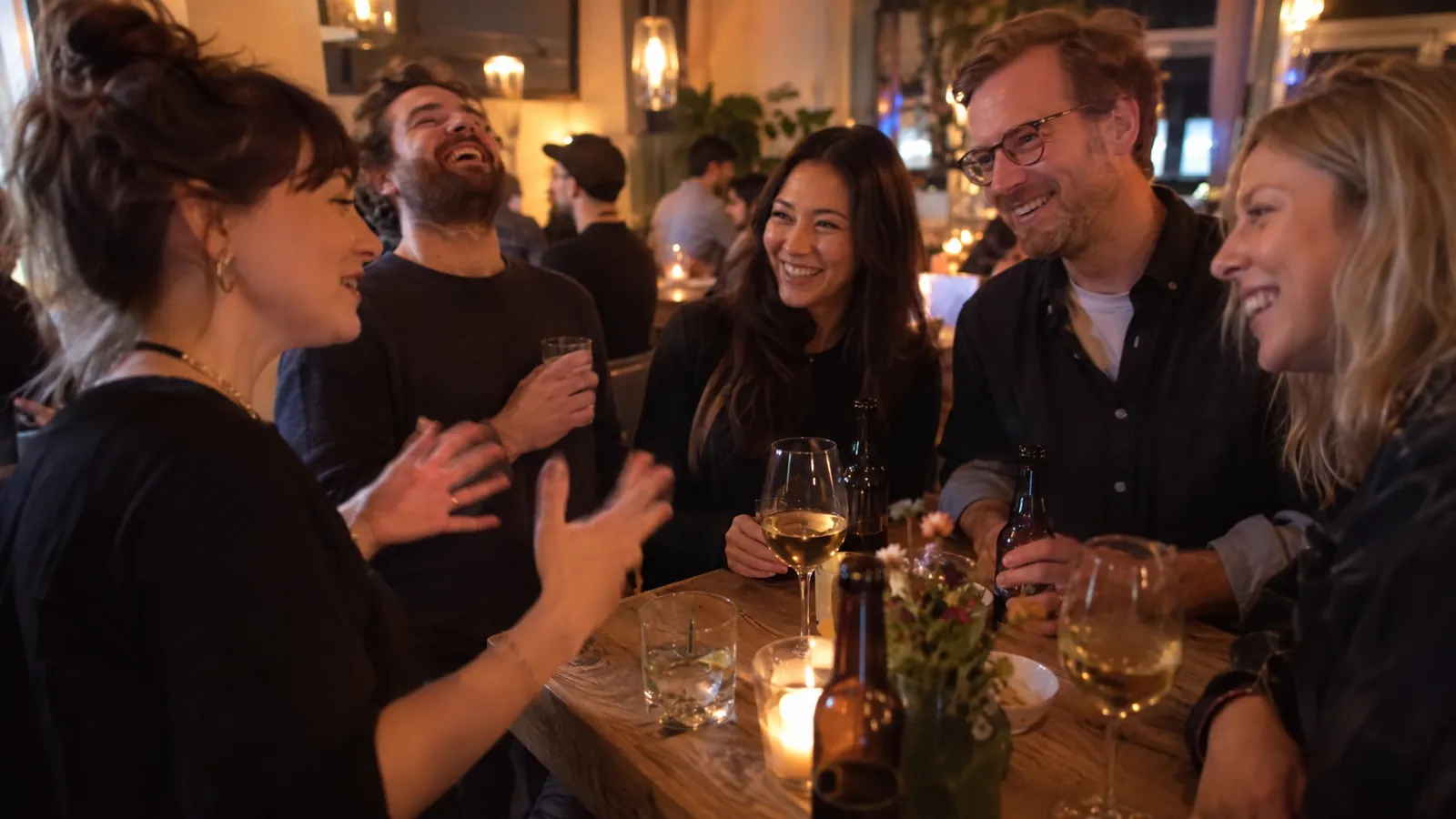
Most guests at a singles event are a little nervous: they want to meet someone without feeling exposed. The good news for hosts is that people enjoy talking to strangers more than they expect. Nicholas Epley and Juliana Schroeder found that commuters asked to talk to a stranger had a more pleasant ride than those who sat in silence, while others predicted the opposite (Journal of Experimental Psychology: General, 2014). That was tested on commuters, not at singles events. Still, your job is to lower the first hurdle.
Pick the right format
The format decides how much courage a guest needs. A room of strangers with drinks asks for a lot, a table with a task for very little.
| Format | Good for | Group size, roughly | Effort | Watch out for |
|---|---|---|---|---|
| Speed dating | Guests who want clarity and many short conversations | About 20, e.g. 10 per side | Medium: tables, timer, seating plan | Balance of the groups; rounds that feel like an interview |
| Mixer in a bar | Low-threshold evenings, regulars, first events | As many as can talk without shouting | Low | Cliques forming; guests standing alone |
| Cooking together | Guests who find it easier to talk while their hands are busy | As many as there are cooking stations | High: kitchen, ingredients, instructor | Cost per head; dietary needs |
| Running or walking | Active guests, morning people | Groups split by pace | Low | Weather; a social part afterwards |
| Quiz night | Mixed groups, guests who like to play | Teams of table size | Medium: questions, host | Teams of friends that stay closed; shuffle teams |
| Dancing or a class | Guests who like movement and music | As many as the floor holds | Medium | Partner changes need to be voluntary |
| Open evening without a singles label | Guests who find "singles" too direct | Small tables, e.g. four to six | Low to medium | Say clearly who the evening is for |
The speed dating sizes follow party.pro, which suggests caps such as 12 per side. These are practical values; no study has shown an ideal group size. There is a hint, though: Alison Lenton and Marco Francesconi analysed decisions of 3,738 participants at 84 British speed dating events. With more options, people paid more attention to features they could judge quickly, such as height and weight, and less to occupation or education (Psychological Science, 2010). The open-evening tables follow Timeleft, whose dinners seat four to six strangers.
Activities also work in unexpected places: the Prussian Palaces and Gardens Foundation runs Museums-Dates at the Schlossmuseum Oranienburg, for example on Friday, 30 October 2026, for singles aged 65 and over (2026 programme): a glass of wine or sparkling wine, a guided tour together and short dates in front of selected artworks.
Who you invite
Be specific about the evening, not about the people. "Singles aged 30 to 45 who like board games" tells guests whether they will feel at home, and age ranges help most guests find people at a similar stage of life.
Balance is a common headache: one group sometimes books out fast while the other trickles in. At CityPickle's singles events in New York, co-CEO Mary Cannon said in a February 2025 report that the women's tickets sold out instantly with a waiting list. If your format depends on balance, use separate ticket quotas and a waiting list; otherwise choose a format where it matters less, such as a quiz or an open evening.
Inclusion works best when it is in the invitation for everyone: who the evening is for, the price, how accessible the venue is and whether there are alcohol-free drinks. No group needs to be singled out for people to feel welcome.
The flow: welcome, icebreakers, rotation, breaks
Welcome. Greet every guest at the door, hand out name tags with first names only and point them to a first drink or a first table.
Explain the evening. Say out loud how long the rounds are, what happens when the bell rings and how guests can find each other afterwards.
Icebreakers. Put question cards on the tables that go a little beyond job and neighbourhood. Arthur Aron and colleagues had pairs of strangers take turns, in a structured procedure of about 45 minutes, with questions that became gradually more personal; afterwards the pairs felt closer than pairs who made small talk (Personality and Social Psychology Bulletin, 1997). The study does not show whether single question cards in short rounds work the same way; as conversation starters they still help.
Rotation. Round lengths vary widely. Eventbrite's organiser guide names two to five minutes; the German provider SpeedDating.de runs seven. Do the maths before you publish a start time: ten rounds of five minutes plus changes is about an hour of talking alone, before the welcome and breaks.
Close well. End with an open part where people can go back to someone they liked.

Room and atmosphere
Choose a place where people can hear each other without shouting. Small tables suit pairs, standing tables mixers. Light should be warm but bright enough to see faces, music low while people talk. A quiet corner to take a breath helps more than you would think.
Safety and awareness
Bars in many German, Austrian and Swiss cities take part in Luisa ist hier!, a campaign started by the Frauen-Notruf Münster in 2016: in participating venues, people can turn to briefed staff by asking "Is Luisa here?". Check beforehand whether your venue takes part and how help works there. An Austrian example: since 1 July 2026, Vienna requires an awareness concept for events that meet all of these conditions: 300 or more guests, a dance floor or standing area in front of the stage, alcohol, music and an end after 9 pm. For smaller evenings the same ideas are a good standard.
Privacy in short, and not as legal advice: never pass on the guest list, and only take or post photos of people who agreed.
The morning after
Whatever channel you choose, keep one-sided interest private. German speed dating providers such as SpeedDating.de ask guests for their choices within 48 hours of the start of the event; party.pro advises sending results within 24 to 48 hours. The sooner, the better.
Checklist
Before the evening
- Choose a format and a room where people can hear each other
- Set an age range, ticket quotas if needed and a waiting list
- Name a contact person for awareness and brief the venue staff
- Decide how guests can find each other afterwards
On the evening
- Greet every guest and hand out first-name tags
- Explain rounds, breaks and the follow-up out loud
- Put question cards on the tables and plan a break at half time
- Ask before taking photos
The morning after
- Send the follow-up while the evening is still fresh
- Share contact details only where both people said yes
- Ask two or three guests what to change next time
Where before fits in
before is a web app for hosts that covers the morning after. Guests check in at the door with a QR code and a selfie. The next morning, checked-in guests can see the selfies of the other checked-in guests; those who left an email address get access by email. One-sided wishes stay invisible, before sends no rejections, and contact only opens if both want it. Whether that leads to a meeting is up to the guests. Nobody needs a profile.