How to Host a Supper Club: Planning, Guests, Morning After
How to host a supper club: concept, venue, menu and costs, pricing, tickets, seating, allergies, the evening itself and the morning after, with a checklist.

A supper club is a ticketed dinner where guests who mostly do not know each other share one table, somewhere between a restaurant and a dinner party at a friend's place. As host you are cook, organizer and master of ceremonies on the same night. This guide walks through the decisions in the order you will meet them.
Start with a concept and a size
Guests book for a reason they can name: a cuisine, a theme, a cook with a story or the promise of meeting new people. In Berlin, the architects Luca Lagorio and Lorenzo Gaveglio built their Rat Supper Club around themed Italian menus, such as a Roman edition and one about Lagorio's native Liguria. Pick one idea and let it shape the menu, the invitation and the table.
Smaller than you think is usually right. The Rat Supper Club seats 10 to 12 people per dinner. The UK home cook behind Kippysnacks caps it at eight. She also describes home supper clubs she attended as a guest that were so cramped that several people had to move so she could get to the loo. Count chairs, plates and the space behind every chair before you count tickets.
Choose the place
Your own flat. Cheapest, and you know your oven. The limits are space, the neighbours and strangers in your home.
A pop-up space. Rentable rooms give you more seats and privacy. In Berlin, for example, Der Weinlobbyist in Schöneberg rents out its room by the hour. Ask what kitchen equipment you can use.
A restaurant on its day off. A professional kitchen, tables and glasses. Agree early on the fee, cleaning, drinks and what the owner's licence covers.
Menu and costs
Choose dishes you have cooked many times and can largely prepare ahead. Alexandra Dudley, a British cook and food writer, recommends a full run-through of the menu before the evening and advises spending real attention on bread, butter and dessert, because dessert is what guests leave with. Kippysnacks shops two to three days ahead and keeps prep and timing sheets on an iPad; she pins the menu up in the kitchen.
For costs, list everything, not just ingredients: drinks, flowers and candles, rentals, paid help and your own hours.
| Format (real example) | Guests | Effort | Price per head |
|---|---|---|---|
| Home dinner, six courses (Landlover Supper Club, Dublin) | not stated, two dinners a month | High | 95 euros |
| Monthly community dinner, sharing dishes (Mingle Collective, Dublin and Belfast) | not stated | Medium | 50 to 80 euros |
| Rotating flats and event spaces, 7 to 8 courses (Rat Supper Club, Berlin) | 10 to 12 per dinner | High | not stated |
| Seven-course tasting menu at one long table on a country estate (The Dining Club, Co. Dublin) | 20 | Very high | from 130 euros |
The Irish examples come from an Irish Times feature (November 2025): orientation, not a benchmark for your city.
Pricing and money
Total costs divided by the seats you realistically fill gives your break-even price per head. Your time is already in there once; do not add it again. Then add a buffer for profit and cancellations if you need one, check whether ticket fees are a percentage of the final price, and say what the price includes, especially wine or an alcohol-free pairing.
Invitations and tickets
Your first guests will likely be friends of friends; ask each to bring someone you have not met. The invitation should state the date, start time, rough end time, neighbourhood (share the exact address after booking), price, what is included and how you handle dietary needs. Dudley puts an ideal leaving time into the confirmation. A mailing list is the best tool for the second date: Kippysnacks gives subscribers 24 hours' early access to new tickets.
Seating and hosting the table
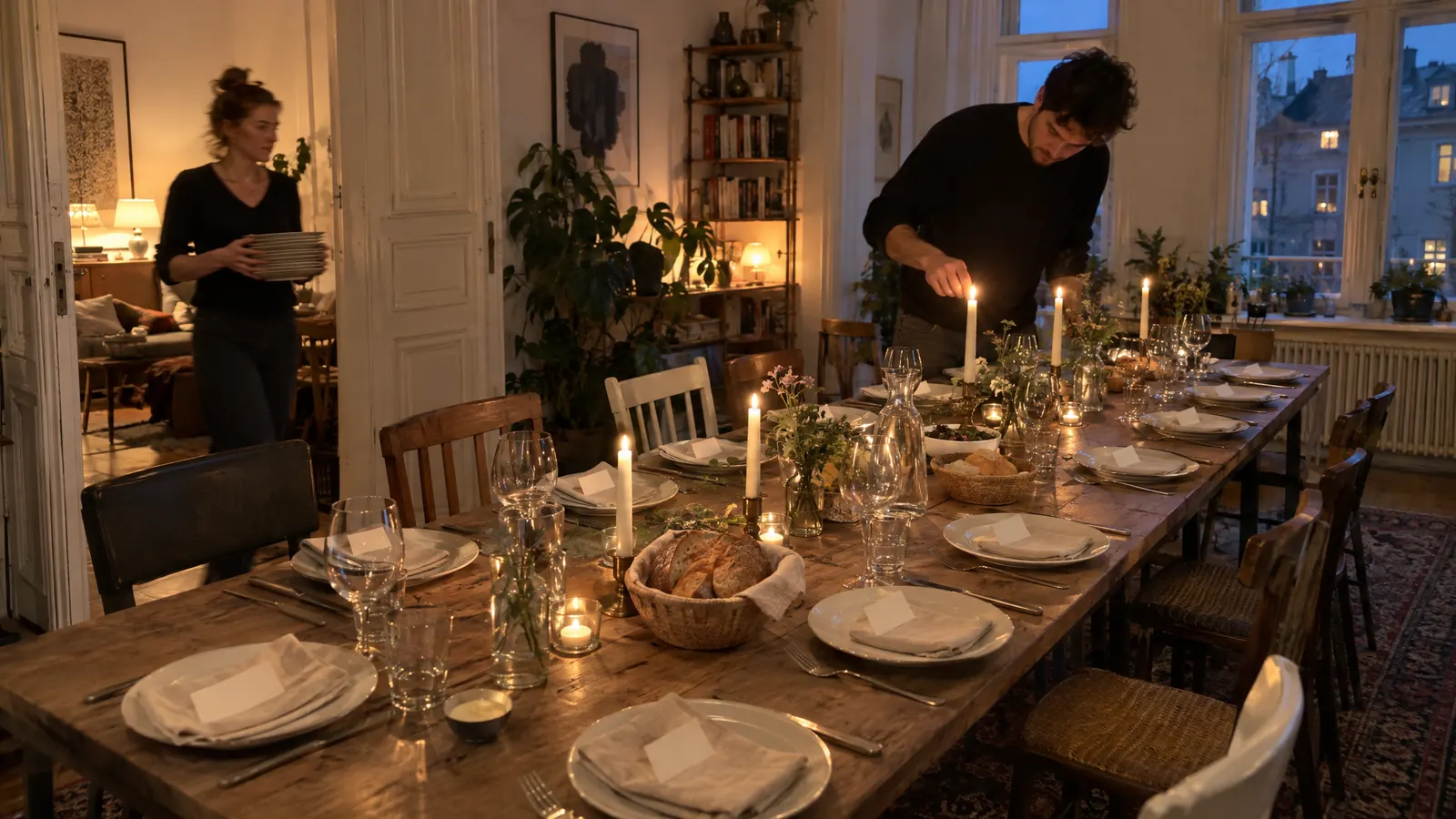
At a long table, the ends can drift out of the conversation. Split up couples and friends, seat a talkative guest between quieter ones and use place cards with first names. Plan for guests who come alone. Dearbhaile Gaffney and Gráinne O'Higgins of Mingle Collective told the Irish Times: "We get a lot of guests who come alone. We really encourage it."
Welcome everyone, introduce the concept in two sentences and connect people ("You two both just moved here").
Allergies and dietary needs
Ask for allergies and diets when people book, not at the table. Say openly what you can safely offer. Kippysnacks offers no allergen-free special menus, because cross-contamination in a home kitchen is a real risk. Limits like these belong in the invitation before people book, but they do not replace the legal allergen information (see below). Keep a written list of ingredients per dish so you can answer questions on the night.
How the evening runs
A typical flow: welcome drink and snacks on arrival, a few words from the host, courses at a steady pace, then dessert and tea in a looser round where people change seats. Plan course timings on paper and get help with serving and washing up, so you can sit down too. Rat Supper Club co-founder Lagorio names the goal simply: "The best achievement is when you hear guests laughing and talking the whole time."
The morning after
The next morning the evening is still fresh; a short message can help guests come back.
- Say thank you the next morning, in a short, personal message.
- Share photos only with the consent of the people in them; in Germany, publishing recognisable photos generally needs permission (§ 22 KUG).
- Name the next date or open the waiting list while the memory is fresh.
- Help guests find each other again. Some guests leave without swapping numbers. How to do this fairly and in line with data protection is covered in our guide on helping guests reconnect after an event.
What to clarify before you charge money
This is not legal advice, only questions to ask. Selling food and drinks regularly can quickly make you a business. In Berlin, a commercial restaurant business that serves alcohol generally needs a restaurant licence, which requires the instruction course at the IHK Berlin or a comparable qualification. A temporary permit only covers special, short occasions. Without alcohol, the licence generally falls away; the trade registration and other requirements remain, such as registering as a food business with the district food authority (example Spandau) and whether you may use the rooms for it. Anyone doing certain food tasks in the kitchen needs a certificate under § 43 IfSG from an initial instruction by the health office or an appointed doctor before starting; employers then instruct staff every two years. Commercial providers must inform guests about 14 substances and groups of substances that can cause allergies (IHK Schwerin). Profits can trigger income tax; for VAT, the small business rule may apply (since 2025 at most 25,000 euros turnover in the previous year and 100,000 euros in the current year), but it is not a general tax exemption.
Checklist
Two weeks before
- Fix the concept, date, number of seats and price
- Test the menu once in full and write the prep plan
- Open ticket sales with a cancellation rule and ask about allergies
- Clarify the business, the rooms and food registration with the authorities
On the day
- Set the table and place cards before the first guest arrives
- Keep the allergy and ingredient list in the kitchen
- Welcome everyone and introduce the concept in two sentences
- Ask before taking or sharing photos
The morning after
- Send a short thank you
- Share photos only with consent
- Announce the next date or open the waiting list
- Give guests a fair way to find each other again
For ideas from the local scene, see our overview of supper clubs in Berlin.
Where before fits
before is a web app for hosts of evenings where people meet. Guests check in at the door with a QR code and take a selfie. The next morning, checked-in guests can see the selfies of the other checked-in guests; those who left an email address get access by email, sent in your name. One-sided wishes stay invisible, before sends no rejections, and contact only opens if both want it. Whether that leads to a meeting is up to the guests. Nobody needs a profile.